Japanese · Snack
Mitarashi Dango
みたらし団子 (Mitarashi Dango)
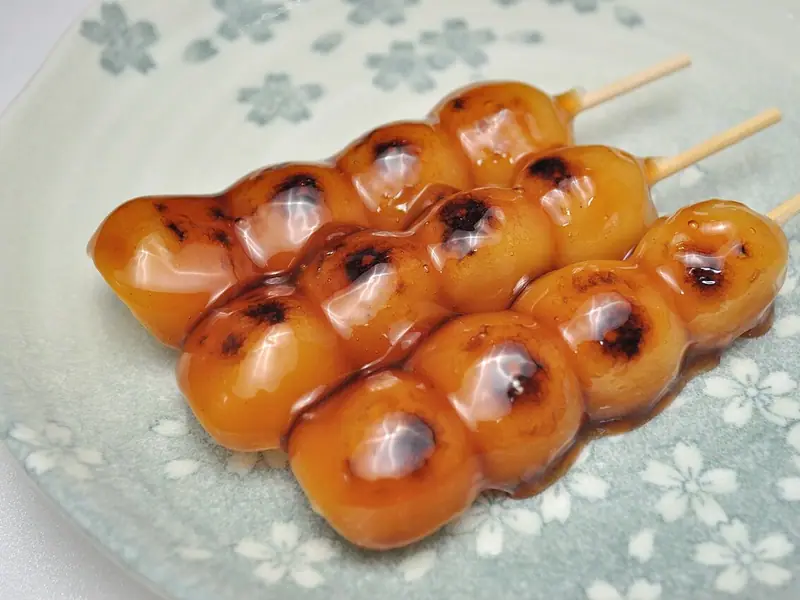
Chewy rice dumplings threaded on skewers, toasted until lightly charred, then coated in a glossy sweet-and-salty soy glaze. This version uses a little less sugar while keeping the classic flavour.
- Prep
- 20 min
- Cook
- 20 min
- Total
- 40 min
- Serves
- 4
Calories come from: Carbs 90% · Fat 3% · Protein 7%
Track it in BerryFit and see how it fits your own daily target. Get the app ›
Ingredients
For 4 servings- 2/3 cup100 gGlutinous rice flour (shiratamako or mochiko)
- 1/3 cup50 gRegular rice flour (joshinko)
- 1/2 cup plus 1 tbsp130 gWarm water for the dough
- about 10 cups2,500 gWater for boiling and cooling
- 2 tbsp32 gSoy sauce
- 2 tbsp25 gGranulated sugar
- 1 tbsp18 gMirin
- 1/3 cup80 gWater for the glaze
- 1 tbsp9 gPotato starch
Steps
- 1
Soak 4 bamboo skewers in water while you make the dough.
- 2
Mix the glutinous rice flour and regular rice flour in a bowl.
- 3
Add the warm dough water a little at a time, kneading until the dough is smooth and feels like a soft earlobe.
- 4
Divide the dough into 12 equal pieces and roll each into a smooth ball.
- 5
Bring about 2 litres of the boiling water to a boil in a large pot, and fill a bowl with the rest as cold water.
- 6
Drop the balls into the boiling water and stir gently so they do not stick.
- 7
Once they float, cook for 2 to 3 more minutes until cooked through.
- 8
Lift the dumplings into the cold water to cool for 1 minute, then drain well.
- 9
Thread 3 dumplings onto each skewer.
- 10
In a small saucepan, whisk the soy sauce, sugar, mirin, glaze water and potato starch until no lumps remain.
- 11
Cook the glaze over medium-low heat, stirring constantly, for 2 to 3 minutes until thick and glossy, then take it off the heat.
- 12
Heat a dry non-stick pan over medium-high heat.
- 13
Toast the skewers for 2 to 3 minutes per side until lightly browned with a few charred spots.
- 14
Brush or spoon the warm glaze over the dumplings and serve right away.
Swaps, storage and make-ahead
Swaps
- For a gluten-free version, use tamari labelled gluten-free instead of soy sauce and a mirin labelled gluten-free.
- Use cornstarch instead of potato starch to thicken the glaze in the same amount.
- If you can't find joshinko, use all glutinous rice flour (1 cup total) for a softer, stretchier dumpling.
- Swap the granulated sugar for light brown sugar for a deeper, more caramel-like glaze.
Storage
Dango are best eaten fresh, as the dumplings turn hard and dry once chilled. If you have leftovers, refrigerate them in an airtight container within 2 hours and eat within 1 to 2 days, softening them by briefly simmering or microwaving until steaming hot; avoid freezing glazed dango.
Make ahead
Make the glaze up to 3 days ahead and keep it covered in the fridge, then rewarm it gently with a splash of water while stirring. Boil and toast the dumplings just before serving for the best chewy texture.
Nutrition values are for the recipe as written.
Track this in BerryFit
Log Mitarashi Dango in one tap and see how it fits your remaining calories for today.
Or ask Coach Berry to change it
Allergens and nutrition
Contains: GlutenSoy
Check the labels of packaged ingredients for allergens and suitability for your diet.
Full nutrition
| Per serving (736 g) | Per 100 g | |
|---|---|---|
| Calories | 171 kcal | 23 kcal |
| Protein | 3.1 g | 0.4 g |
| Carbohydrates | 38.8 g | 5.3 g |
| of which sugars | 7.5 g | 1 g |
| Fiber | 0.4 g | 0.1 g |
| Fat | 0.5 g | 0.1 g |
| of which saturated | 0.1 g | 0 g |
| Sodium | 482 mg | 65 mg |
Nutrition is calculated from USDA FoodData Central data and may differ from what you cook.