Japanese · Breakfast · Lunch · Snack
Tamagoyaki
卵焼き (Tamagoyaki)
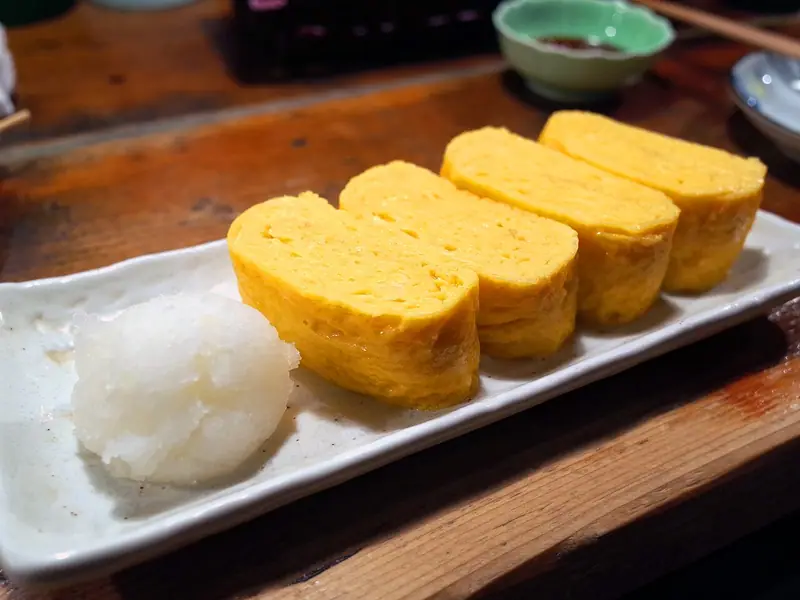
Soft, lightly sweet Japanese rolled omelette built up from thin layers of egg seasoned with dashi, soy and mirin. It is cooked with just a teaspoon of oil for a light breakfast or bento favourite.
- Prep
- 10 min
- Cook
- 12 min
- Total
- 22 min
- Serves
- 2
Calories come from: Carbs 15% · Fat 57% · Protein 28%
Track it in BerryFit and see how it fits your own daily target. Get the app ›
Ingredients
For 2 servings- 4 large200 gEggs
- 1/4 cup60 gDashi stock, cooled
- 1 tbsp18 gMirin (sweet rice seasoning)
- 1 tsp6 gSoy sauce
- 1 tspSugar
- 1 small pinchSalt
- 1 tsp5 gNeutral oil (e.g. canola)
- 1 stalk10 gSpring onion, finely sliced (optional)
Steps
- 1
Crack the eggs into a bowl.
- 2
Add the dashi, mirin, soy sauce, sugar and salt.
- 3
Beat gently with chopsticks, cutting through the whites rather than whipping, so the mixture blends without much foam.
- 4
Stir in the spring onion, if using.
- 5
Pour the oil into a small dish and fold a paper towel into a pad to wipe the pan.
- 6
Heat a rectangular tamagoyaki pan or small non-stick frying pan over medium-low heat and wipe it lightly with the oiled paper towel.
- 7
Pour in a thin layer of egg, about a quarter of the mixture, and tilt the pan to cover the base.
- 8
Pop any large bubbles with chopsticks and cook until the egg is mostly set but still slightly moist on top, about 1 minute.
- 9
Roll the egg from the far side towards you into a log.
- 10
Push the log back to the far side and wipe the empty part of the pan with the oiled towel.
- 11
Pour in another thin layer of egg, lifting the log so the raw egg flows underneath it.
- 12
When almost set, roll the log back towards you over the new layer.
- 13
Repeat with the remaining egg until it is all used.
- 14
Cook the finished roll for another 30 seconds on each side so the centre is fully set with no runny egg.
- 15
Wrap the hot roll in a bamboo mat or a sheet of baking paper and press it gently into a neat block.
- 16
Rest for 3 minutes, then unwrap and slice into 2 cm pieces.
Swaps, storage and make-ahead
Swaps
- Use tamari labelled gluten-free instead of soy sauce, and check that your dashi and mirin are also labelled gluten-free, for a gluten-free version.
- Use kombu dashi in place of bonito-based dashi to make it vegetarian.
- Swap the mirin for an extra 1/2 tsp sugar and 2 tsp water if you can't find mirin.
- Leave out the sugar for a more savoury omelette, or skip the spring onion for a plain roll like the one pictured.
Storage
Refrigerate leftovers in an airtight container within 2 hours and eat within 3 to 4 days, either cold or reheated until steaming hot. Freezing is not recommended, as the texture turns watery and rubbery.
Make ahead
You can mix the dashi, mirin, soy sauce, sugar and salt up to a day ahead and keep it in the fridge. The cooked, sliced roll can also be made the night before for bento boxes and kept chilled until packing.
Nutrition values are for the recipe as written.
Track this in BerryFit
Log Tamagoyaki in one tap and see how it fits your remaining calories for today.
Or ask Coach Berry to change it
Allergens and nutrition
Contains: EggsFishSoyGluten
Check the labels of packaged ingredients for allergens and suitability for your diet.
Full nutrition
| Per serving (147 g) | Per 100 g | |
|---|---|---|
| Calories | 198 kcal | 135 kcal |
| Protein | 13.4 g | 9.1 g |
| Carbohydrates | 7.2 g | 4.9 g |
| of which sugars | 6.3 g | 4.3 g |
| Fiber | 0 g | 0 g |
| Fat | 12 g | 8.2 g |
| of which saturated | 3.3 g | 2.2 g |
| Sodium | 518 mg | 352 mg |
Nutrition is calculated from USDA FoodData Central data and may differ from what you cook.