Korean · Lunch · Dinner
Seolleongtang (Korean Ox Bone Soup)
설렁탕
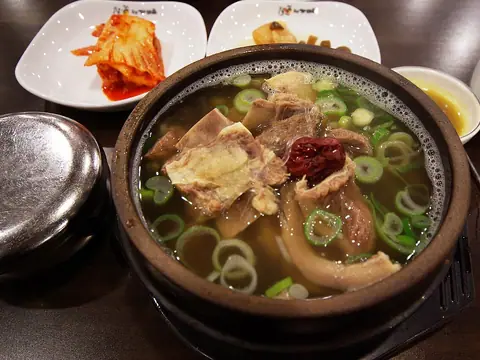
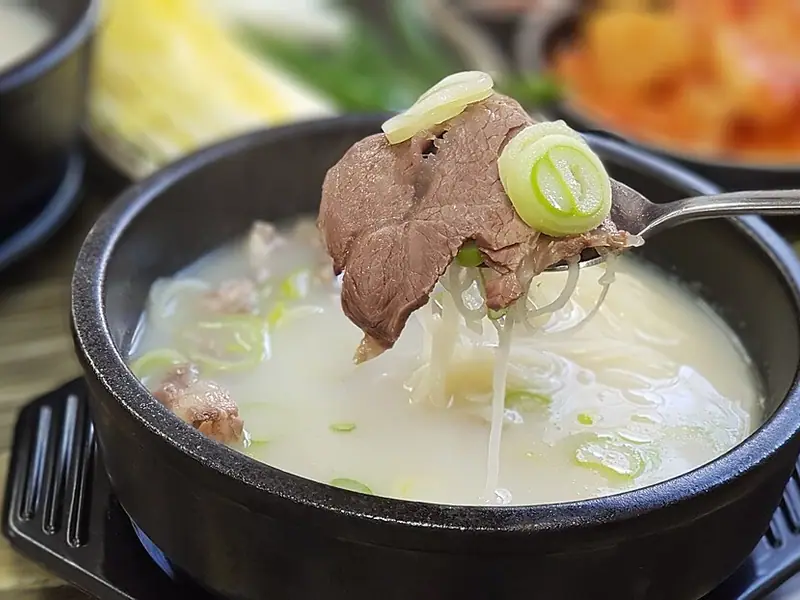
A milky, gently seasoned beef bone broth simmered low and slow, served with tender slices of lean brisket, soft radish, thin noodles and plenty of fresh scallions. Each bowl is seasoned at the table with salt and pepper, just like in Seoul's classic soup houses.
- Prep
- 135 min
- Cook
- 385 min
- Total
- 520 min
- Serves
- 4
Calories come from: Carbs 53% · Fat 12% · Protein 35%
Track it in BerryFit and see how it fits your own daily target. Get the app ›
Ingredients
For 4 servings- 1.5 kg, discarded after simmeringBeef leg or knuckle bones (optional)
- 400 gLean beef brisket (flat), trimmed
- about 16 cups, discarded4,000 gCold water for soaking and blanching (optional)
- about 19 cups4,500 gWater for simmering
- 1 large piece300 gKorean radish (mu), peeled
- 1 medium, strained out150 gOnion, halved (optional)
- 6 cloves, strained out18 gGarlic cloves, peeled (optional)
- 200 g dry (about 560 g cooked and drained)Somyeon (thin wheat noodles)
- about 8 cups, drained off2,000 gWater for boiling the noodles (optional)
- 4 stalks60 gGreen onions, finely sliced
- 3/4 tsp5 gSea salt
- 1/2 tspGround black pepper
Steps
- 1
Place the bones in a large bowl, cover with about 3 litres of the cold soaking water and soak for 2 hours, changing the water once, to draw out blood.
- 2
Drain the bones, put them in a large pot with the remaining 1 litre of blanching water plus enough to cover, and boil hard for 10 minutes.
- 3
Drain the bones, discard the water, and rinse the bones and pot clean of any scum.
- 4
Return the bones to the pot with the 4.5 litres of simmering water and bring to a boil.
- 5
Lower the heat and simmer, partly covered, for 4 1/2 hours, skimming off fat and foam regularly; top up with a little hot water if the bones become exposed.
- 6
Add the brisket, whole radish, onion and garlic to the pot.
- 7
Simmer for another 90 minutes, until the brisket is tender and reaches at least 71 °C / 160 °F inside, and the broth is cloudy white.
- 8
Lift out the brisket and radish and let them cool slightly; discard the onion, garlic and bones.
- 9
Strain the broth and skim off as much surface fat as possible with a ladle or fat separator.
- 10
Slice the brisket thinly against the grain and cut the radish into thin squares.
- 11
Bring the 2 litres of noodle water to a boil in a separate pot, cook the somyeon for 3 minutes, then drain and rinse under cold water.
- 12
Return the sliced brisket and radish to the hot broth to warm through for 2 minutes.
- 13
Divide the noodles among bowls, ladle over the broth with beef and radish, and top with green onions.
- 14
Serve with the salt and black pepper on the side so everyone can season their own bowl, tasting before adding more.
Swaps, storage and make-ahead
Swaps
- Use rice noodles instead of somyeon for a gluten-free bowl, since every other ingredient here is naturally gluten-free.
- Serve the soup over a small scoop of steamed short-grain or brown rice instead of noodles, as many Seoul soup houses do.
- Swap Korean radish for daikon, which is easier to find and cooks up just as soft and mild.
- Use beef shank instead of brisket if you prefer a leaner cut with a slightly chewier bite.
Storage
Refrigerate the broth, beef and radish within 2 hours and use within 3 to 4 days, reheating until steaming hot; keep the noodles separate, as they turn mushy in the broth and are best cooked fresh. The strained broth (without noodles) freezes well for about 3 months.
Make ahead
Make the broth, brisket and radish a day ahead, then chill overnight so you can lift off the solid fat before reheating. Cook the noodles and slice the green onions just before serving.
Nutrition values are for the recipe as written.
Track this in BerryFit
Log Seolleongtang (Korean Ox Bone Soup) in one tap and see how it fits your remaining calories for today.
Or ask Coach Berry to change it
Allergens and nutrition
Contains: Gluten
Check the labels of packaged ingredients for allergens and suitability for your diet.
Full nutrition
| Per serving (1,456 g) | Per 100 g | |
|---|---|---|
| Calories | 326 kcal | 22 kcal |
| Protein | 28.1 g | 1.9 g |
| Carbohydrates | 42.8 g | 2.9 g |
| of which sugars | 2.2 g | 0.2 g |
| Fiber | 1.7 g | 0.1 g |
| Fat | 4.5 g | 0.3 g |
| of which saturated | 1.6 g | 0.1 g |
| Sodium | 810 mg | 56 mg |
Nutrition is calculated from USDA FoodData Central data and may differ from what you cook.